In the harsh environment of space, even a tiny leak can lead to mission failure, costing millions and risking years of development.
Helium leak detection in aerospace is the primary defence against such disasters, allowing engineers to find and fix defects before launch, when it's still possible to make changes.
Spacecraft and satellite testing require exceptionally high precision. Propulsion systems, pressurised fuel tanks, thermal management loops, and sealed electronics enclosures all need to be completely airtight under extreme vacuum and temperature changes. Helium is the preferred gas for testing these critical seals because of its unique properties: it's non-reactive, has a small atomic radius, and can be detected at very low levels.
For aerospace engineers, quality assurance managers, and systems integrators involved in satellite and launcher projects, the challenge goes beyond just finding leaks: test solutions must provide consistent results, complete documentation, and adherence to international aerospace standards. MVS Technologies designs flexible helium leak testing systems specifically to fulfil these needs, collaborating with teams in the space industry to create defect-free environments necessary for successful missions.
The critical role of helium leak detection in aerospace systems
Helium has established itself as the tracer gas of choice for spacecraft leak testing and satellite hermeticity testing due to its unique physical properties. Thanks to their small size, helium molecules can penetrate microscopic defects, which is critical when a leak could spell the difference between mission success and catastrophic failure. The gas's inert nature eliminates any risk of chemical reaction with sensitive aerospace materials, from titanium alloy fuel tanks to composite structures, whilst its low background concentration in Earth's atmosphere provides exceptional signal-to-noise ratios during testing.
The rigorous demands of leak testing for propulsion systems alone justify the aerospace sector's reliance on helium-based methods. Helium leak detection in aerospace applications extends across virtually every pressurised or vacuum-sealed system aboard modern spacecraft and satellites:
- Propulsion systems: Bipropellant tanks, monopropellant thrusters, and pressurant vessels, where even minute leaks can alter thrust profiles or contaminate propellant chemistry
- Thermal control systems: Radiator loops and heat pipes containing working fluids that must maintain precise charge quantities throughout multi-year missions
- Pressurisation systems: Life support modules and habitable compartments where crew safety depends on absolute hermeticity
- Electronic enclosures: Hermetically sealed avionics boxes protecting sensitive circuitry from vacuum exposure and atomic oxygen degradation
- Payload modules: Scientific instruments requiring stable internal environments, particularly those with optical elements or precision sensors
- Solar array assemblies: Sealed junction boxes and rotating mechanisms that must function reliably across thousands of thermal cycles.
Consequences of undetected leaks in space missions
The unforgiving environment amplifies minor issues on Earth into mission-ending events, where the integrity of aerospace components determines whether a satellite reaches its design life or becomes orbital debris within months.
Cascading system failures
Propulsion systems are particularly vulnerable. A microscopic leak in a thruster valve assembly can deplete fuel reserves over time, compromising orbital manoeuvres and station-keeping capabilities. When a satellite cannot maintain its designated orbit, collision avoidance becomes impossible, and the mission timeline collapses. The leak itself may be small, but the mission failure due to leaks stems from a chain reaction: reduced thrust authority leads to drift, drift causes communication blackouts, and blackouts prevent ground intervention.
Thermal management degradation
Radiator loops and thermal control systems depend on precise fluid volumes to maintain operational temperatures across spacecraft subsystems. Electronics designed to operate within narrow temperature bands experience accelerated degradation when cooling capacity drops by as little as 15%. The impact of leakage on spacecraft performance extends beyond the thermal subsystem itself: processors throttle performance, batteries suffer capacity loss, and optical instruments drift out of calibration as mounting structures expand unevenly.
Launch phase vulnerabilities
Pre-launch leak detection prevents disasters during ascent, where rapid pressure changes stress every sealed joint and weld. A leak that remains stable at ground pressure can widen catastrophically during the transition through maximum dynamic pressure, potentially causing structural failure or explosive decompression of pressurised modules.
Helium leak testing techniques tailored for space systems
Hard vacuum testing is the foundation of helium leak testing for space systems, replicating the near absolute vacuum conditions encountered in orbit. In a hard vacuum setup, the chamber is evacuated using a vacuum pumping arrangement, and a mass spectrometer continuously monitors for helium that passes through microscopic defects, revealing leaks that remain invisible to standard pressure decay tests.
Within hard vacuum testing, the most common tracer gas approaches vary based on component geometry, accessibility, and the required sensitivity:
- Vacuum envelope: The component is pressurised with helium and enclosed in an evacuated chamber; the mass spectrometer analyses the chamber atmosphere for helium.
- Spraying: With the chamber evacuated and the test setup connected to the leak detector, helium is sprayed onto joints and potential leak paths to pinpoint defect locations.
- Bombing: Hermetically sealed components are exposed to helium at elevated pressure for a defined period, then transferred to a vacuum chamber where any absorbed helium escaping is measured by the mass spectrometer.
Note: If helium is not used, a similar vacuum envelope setup can be used for vacuum decay testing by monitoring pressure changes over time; however, tracer gas methods typically deliver higher sensitivity.
- Sniffing technique: A probe connected to the mass spectrometer scans external surfaces of pressurised assemblies, detecting localised helium emissions.
- Accumulation methods: Helium filled components are sealed within a known volume; concentration increases over time reveal leak rates too low for immediate detection.
How MVS Technologies supports high-reliability aerospace leak testing
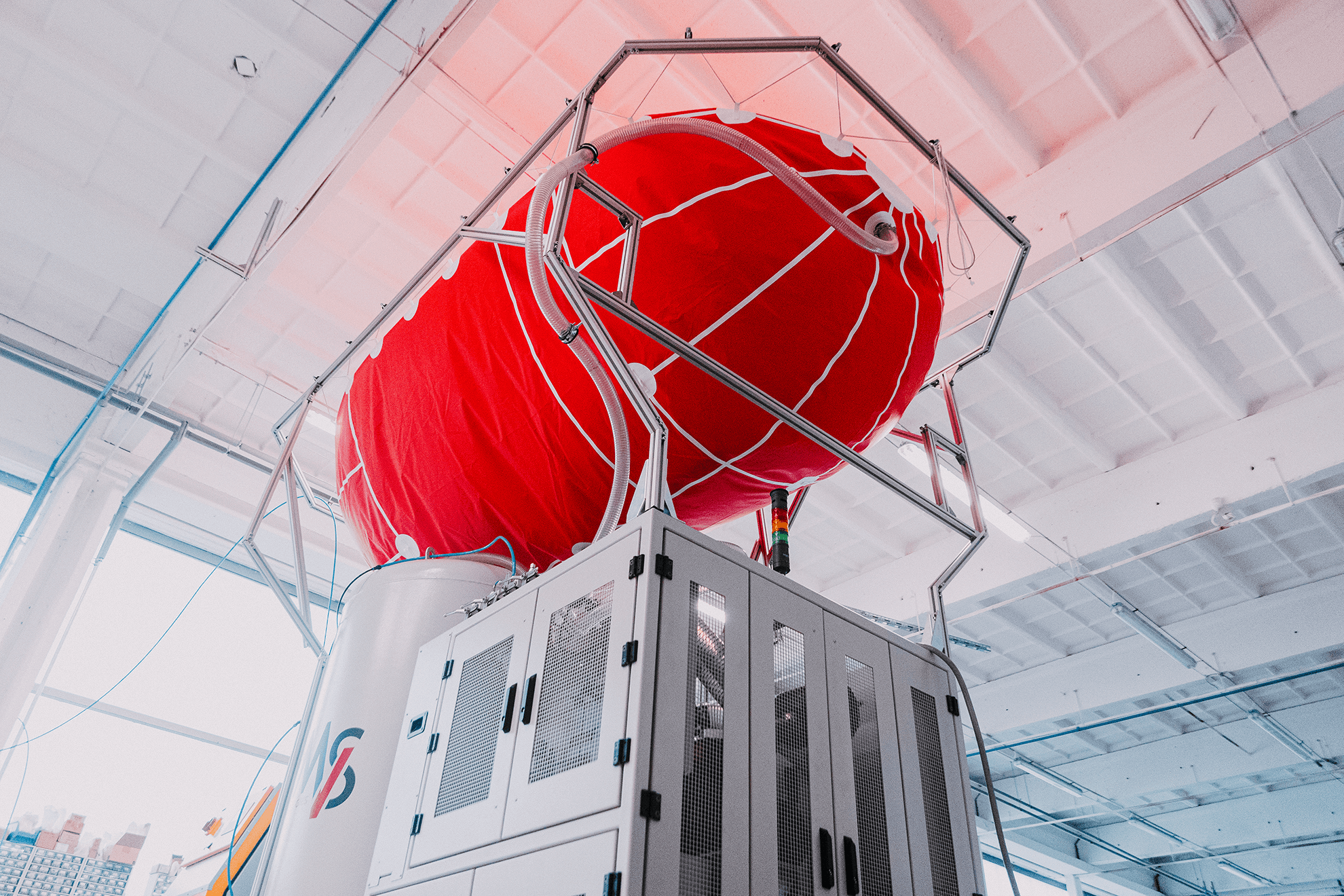
MVS Technologies offers modular helium leak test systems specifically designed for the precision standards of the aerospace industry. These systems can accommodate a wide range of spacecraft components, from miniature electronic enclosures to large propellant tanks.
This is made possible by configurable test chambers, interchangeable tooling, and scalable vacuum-pumping arrangements. The modular design allows aerospace manufacturers to adapt test configurations as programme requirements change, avoiding costly new installations and long lead times.
Custom vacuum chambers for space simulation
Custom vacuum chambers are the foundation of MVS Technologies' space simulation capabilities. These chambers replicate the pressure conditions encountered during launch and orbital operations, enabling engineers to validate leak integrity under realistic vacuum conditions. Where temperature cycling is required, testing is typically performed in thermal vacuum (TVAC) chambers, which combine high vacuum with controlled heating and cooling to simulate extreme hot and cold space environments.
Traceable data logging for aerospace tests
Each test system includes traceable data logging capabilities. This means that every aerospace test conducted using MVS Technologies' systems can be traced back to calibration certificates and component serial numbers. Real time data capture records vital information such as:
- Leak rates
- Chamber pressures
- Temperature profiles
- Test duration
This documentation is crucial for qualification testing, flight readiness reviews, and post-mission analysis.
Collaboration with system integrators
MVS Technologies' engineering team works directly with systems integrators during project design. This collaboration allows them to translate specific mission requirements into test protocols. By partnering with systems integrators in this way, MVS ensures that its leak detection methodologies are compatible with:
- Component geometries
- Material compatibility constraints
- Acceptance criteria defined by space agencies or prime contractors
Helium leak detection mission success in aerospace depends on precision-engineered test solutions that match the unforgiving demands of space environments. From propulsion assemblies to thermal management systems, every component must demonstrate absolute integrity before launch and throughout operational life.
MVS Technologies approaches aerospace leak testing as a collaborative development partnership rather than a transactional supply relationship. Our modular systems adapt to evolving mission requirements, whilst custom vacuum chambers could replicate the thermal-vacuum conditions spacecraft will encounter in orbit. This flexibility ensures that whether you're validating a single satellite subsystem or qualifying an entire launcher programme, your test infrastructure scales with programme complexity.
How helium leak detection safeguards spacecraft and satellite systems ultimately comes down to engineering confidence: knowing that every seal, joint, and pressure boundary has been validated to detection thresholds that prevent mission-compromising failures. MVS Technologies delivers that confidence through solutions designed specifically for the zero-defect standards aerospace programmes demand, supporting your mission from ground test to orbital operations.